Between Two Worlds: Why the Commute Could Be Britain's Most Undervalued Health Resource
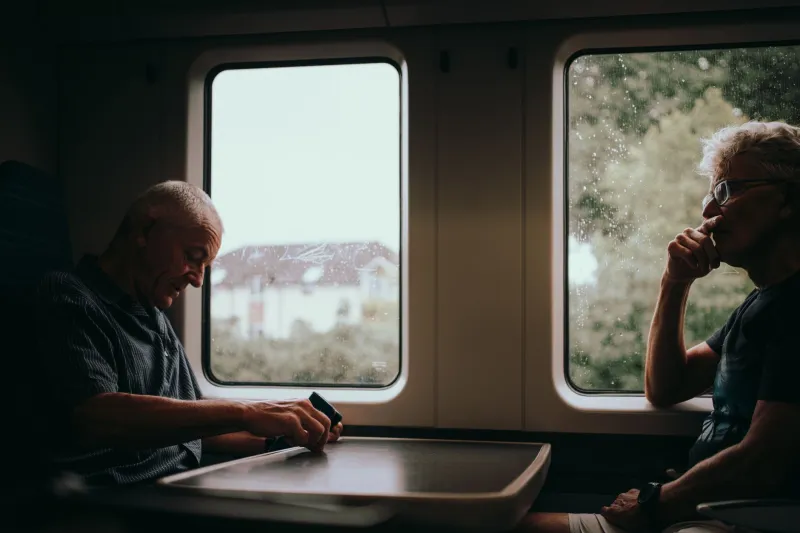
Few features of British life attract as much universal complaint as the commute. It is the standing joke of the morning, the thing hybrid working promised to abolish, the twenty-five minutes on a delayed Northern line train that we all agree should not exist. And so we treat it as pure loss — time subtracted from life, to be endured with headphones and resentment.
I want to argue the opposite. The commute, properly understood, may be one of the most important pauses available to the modern British worker. Not despite its inconvenience, but because of what it offers: a threshold. And thresholds, in Ayurvedic thinking, are not obstacles to be rushed through. They are processes to be honoured.
The Problem of Undigested Transition
Ayurveda's central insight is that everything taken in must be digested — not only food, but experience. The day's events, conversations, stresses and demands all require processing, and the body needs protected time to do that processing. When it does not get it, the undigested accumulates. Ayurveda calls this ama: the residue of things the system could not fully metabolise.
Now consider how most of us move between our two worlds. Home and work are not merely different locations; they are different modes of being — different expectations, different versions of ourselves. Yet the transition between them typically consists of a phone in one hand, notifications streaming in, the mind already at the destination before the body has arrived. We walk through the front door still composing an email, or we open the laptop still carrying the morning's domestic friction.
The transition is never completed. It is skipped. And a skipped transition is, in effect, an undigested experience — one more fragment of unprocessed demand sitting in the nervous system. Multiply that across hundreds of days and you have a plausible account of why so many British workers report feeling perpetually scattered: present nowhere, because they never fully arrive anywhere.
What the Journey Offers
The commute — tedious, drizzly, delayed — is a rare pocket of enforced liminality. You are neither at work nor at home. Nobody can quite reach you. This is precisely the condition the ancient texts would recognise as valuable: a space where the previous mode of being can settle and the next one has not yet begun.
The question is whether we use it or squander it. Squandering looks like scrolling, worrying, drafting replies in your head, listening to news that keeps the nervous system at a low simmer. Using it looks something like a ritual.
Micro-Practices for the Threshold
None of this requires incense or an app subscription. It requires only intention applied to time you are already spending.
On the outbound journey: Try arriving at your first destination before you engage with it. Twenty minutes of no phone — simply looking out of the window, letting the day's thoughts complete themselves. If you are walking or cycling, treat the movement itself as the practice: a deliberate walk is one of the oldest prescriptions for settling the mind.
On the return: Build a deliberate marker at the threshold of home. Before you go inside, take three slow breaths on the doorstep. It sounds almost too small to matter, but the body learns patterns quickly, and a consistent breath at the door teaches the nervous system where one world ends and the next begins.
For drivers: Rather than filling the journey with radio, try ten minutes of silence on the way home. Silence, in the Ayurvedic framework, is not emptiness but digestion — the space in which the day actually gets absorbed.
For the hybrid worker: The temptation is to collapse the commute entirely, and with it the transition. If you work from home, create a substitute threshold: a ten-minute walk around the block before logging on and again before logging off. The body does not care that the office is upstairs. It cares that a boundary was marked.
A Different Verdict on the Commute
The national debate about returning to offices tends to frame the commute as a cost — a tax on the worker, a bargaining chip for the employer. That framing may be economically defensible, but it is physiologically crude. Human beings are not designed to live in an undifferentiated stream. We need edges, and edges need time.
The commute is that time, already built into the day. The British worker does not need less journey. She needs a journey she is allowed to treat as hers.