Starved of Sweetness: What Overscheduled British Childhoods Are Doing to the Body's Vital Reserves
Walk past any primary school at half three on a Tuesday afternoon and you will witness a particular kind of modern British choreography. Children emerge, rucksacks heavy, only to be transferred directly into the back seat for the journey to swimming lessons, coding club, or tutoring sessions. The schedule is full. The diary is managed. The childhood, in some important sense, is being administered rather than lived.
This is not a criticism of the parents who arrange these timetables — they are, in nearly every case, motivated by genuine love and legitimate anxiety about an uncertain future. But Ayurvedic medicine, which has been observing the conditions of human flourishing for millennia, would note something important in what this arrangement costs the child. And the cost, it turns out, is not merely one of time.
Childhood as a Biological Season
Ayurveda divides human life into three broad phases, each governed by a dominant dosha. The first phase — from birth through to adolescence — belongs to Kapha. This is not incidental. Kapha, composed of the elements of earth and water, is the dosha of building, nourishment, and consolidation. It is the force responsible for growth, for the gradual accumulation of tissue, and for the development of ojas — the refined essence of all bodily nourishment, sometimes described as the body's fundamental vitality or immunity.
Ojas is built slowly. It requires adequate sleep, wholesome food, warmth, genuine rest, and — crucially — experiences that carry what Ayurveda calls sweetness. Not sweetness in the narrow culinary sense, though that matters too, but the richer quality of delight: sensory richness, spontaneous play, the pleasure of being fully absorbed in something for no productive reason whatsoever.
When the Kapha phase of childhood is not honoured — when its natural rhythms are overridden by adult imperatives of productivity and performance — the accumulation of ojas is disrupted. Children arrive at adolescence, and eventually adulthood, with reserves that are already diminished. The consequences are not always immediately visible, but they are real.
The Screen Variable
No examination of contemporary British childhood can avoid the question of screens. The average British child now spends more than four hours daily in front of a device, a figure that rises considerably during school holidays. This is not simply a matter of sedentary behaviour, though that dimension matters. From an Ayurvedic perspective, screens present a more particular problem.
Digital media, by design, delivers rapid, high-stimulus input that agitates Vata — the dosha of movement, speed, and the nervous system. The constant micro-stimulation of scrolling, gaming, and algorithmic content creates a state of perpetual alertness that is antithetical to the slow, grounded quality that Kapha childhood requires. Children who spend significant portions of their day in this state are not resting between activities; they are sustaining a low-level physiological arousal that gradually depletes prana — the vital life force that animates all bodily function.
Prana and ojas are intimately related. When prana is scattered through excessive stimulation, the conditions necessary for ojas to accumulate are undermined. The child who appears wired and restless in the evening, resistant to sleep, and difficult to settle is often displaying the signature of a Vata-aggravated nervous system that has simply not had sufficient opportunity to return to its baseline.
What Genuine Nourishment Looks Like
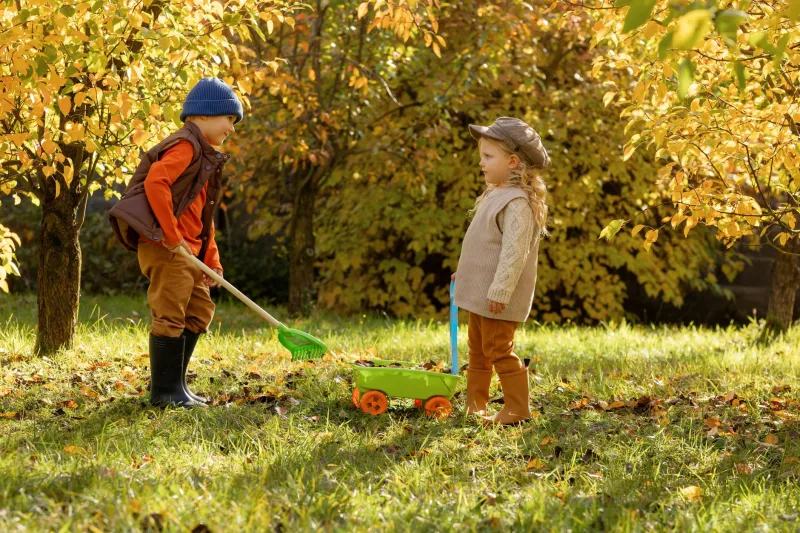
Ayurvedic texts describe childhood as a time when the senses should be fed with beauty, texture, sound, and movement — not as educational enrichment, but as a fundamental biological requirement. The child who spends an afternoon making mud pies, building dens, or simply lying in the garden watching clouds is not wasting time. They are, in the precise language of Ayurveda, building ojas.
This understanding reframes what we might call the pedagogy of unstructured play. It is not a luxury or an indulgence that thoughtful parents permit when the important work is done. It is, from the perspective of ancient medicine, the most important work of childhood — the patient, unhurried accumulation of vital reserves that will sustain the individual through all the demands that adult life will eventually make.
Practical Restoration for British Families
The following suggestions are not offered as a programme or a prescription, but as an invitation to restore what has, in many households, been quietly eroded.
Protect unstructured time as rigorously as scheduled activities. If the diary is full, something must be removed. The capacity to be bored, and to move through boredom into genuine creative engagement, is a skill that requires practice and space. Children who are never bored never develop it.
Bring sensory richness back into the home. Cooking together, handling dough, tending plants on a windowsill, making simple things with their hands — these activities feed the senses in the grounded, Kapha-nourishing way that screens cannot replicate. The kitchen, in particular, is one of the most potent educational environments a child can inhabit.
Observe the Ayurvedic guidance on food for children. The Kapha constitution of childhood is genuinely nourished by warm, slightly sweet, easily digestible foods — porridge, root vegetable soups, warm milk with a small quantity of honey and spice, freshly cooked grains. The cold, processed, and heavily stimulating foods that dominate British children's diets are, in Ayurvedic terms, precisely counter to what this life stage requires.
Restore early and consistent sleep. Ojas is built during sleep, particularly in the hours before midnight. A child who is regularly awake until ten or eleven o'clock, regardless of the reason, is missing the physiological window during which the most restorative processes occur. The Ayurvedic recommendation for children is lights out by eight, ideally preceded by a warm bath and a calm, screen-free wind-down.
Spend time in nature, regularly and without agenda. Britain's parks, beaches, moorlands, and woodland walks are extraordinary resources. The child who is regularly in contact with natural environments — mud, wind, rain, the smell of earth — is receiving a form of Kapha nourishment that no indoor activity can adequately substitute.
The Long View
Ayurveda's understanding of childhood is, at its heart, a long-term investment perspective. The ojas accumulated during these early years becomes the foundation upon which the entire arc of a person's health is built. Adolescence will draw upon it. Young adulthood will draw upon it. Every period of stress, illness, or demand will draw upon it.
A childhood that is rich in sweetness — in play, in sensory experience, in rest, in warmth — is not a soft or indulgent one. It is, in the most rigorous Ayurvedic sense, an act of profound preparation. The most generous thing a parent can offer a child in contemporary Britain may not be a fuller schedule, but a deliberately emptier one.